Repeated sprint exercise
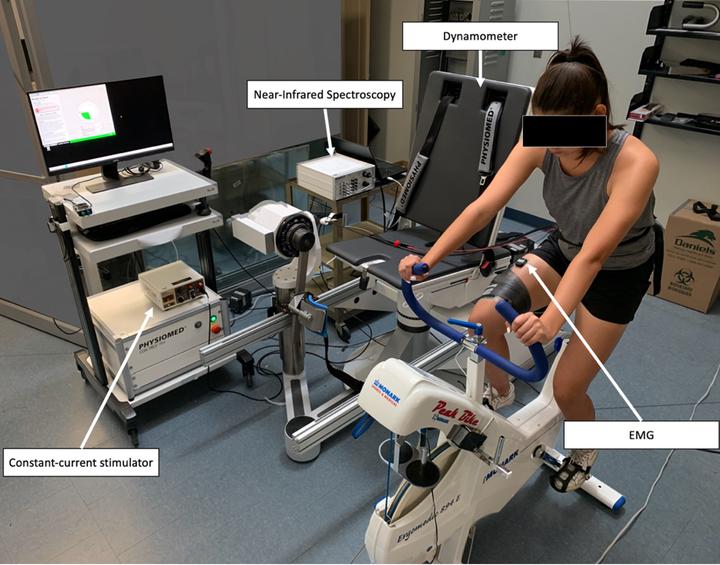
It is postulated that females' lower fatigue responses-induced by high-intensity exercise is attributed to the lower mechanical work performed compared to males. The objective of this study was to compare peripheral (quadriceps twitch force, muscle deoxygenation) and central (voluntary activation) fatigue mechanisms between the sexes during repeated all-out cycling. The novel aspect of this work was that we covaried for total mechanical work and corrected the NIRS data for subcutaneous adipose tissue thickness, facilitating intersubject comparison. We found that females showed greater fatigue resistance in the locomotor muscles: lower muscle deoxygenation, peripehral fatigue, as well as smaller reduction in maximal rate of force development (related to excitation-contraction coupling). We speculate that this is ultimately due to sex differences in muscle metabolism related to their muscle fiber type I/II. Manuscript is currently in preparation and was presented at CSEP conference.
Yoon S, Cederbaum LA, Côté JN. Females show less decline in contractile function than males after repeated all-out cycling. Appl Physiol Nutr Metab. 2023;apnm-2023-0184.
Cederbaum LA, Yoon S, Côté JN. Males and females have similar neuromuscular coordination strategies of the quadriceps during fatiguing repeated all-out cycling. Front Sports Act Living. 2023;5:1248303.
Yoon, S., Cederbaum, A. L., & Côté, J. N. (2021). Does adjusting for mechanical work affect sex differences in peripheral and central fatigue during repeated sprints? CSEP Annual General Meeting - Zooming into the Future: Exercise Science in the Virtual Age. Oral presentation.

SangHoon Yoon
PhD Candidate
My research interests include sex differences in fatigue responses during high-intensity exercise.